

Quick Answer
Confirm the doll's exact material and manufacturer instructions first. Remove clothing, wigs, and detachable parts; protect electronics and connectors; clean with lukewarm water, a soft lint-free cloth, and a mild product approved for that model; remove all residue; and dry every surface, fold, opening, and removable insert completely before storage. Do not improvise with bleach, solvents, abrasive tools, high heat, or unapproved oils, powders, and stain removers.
The Safe Baseline Routine
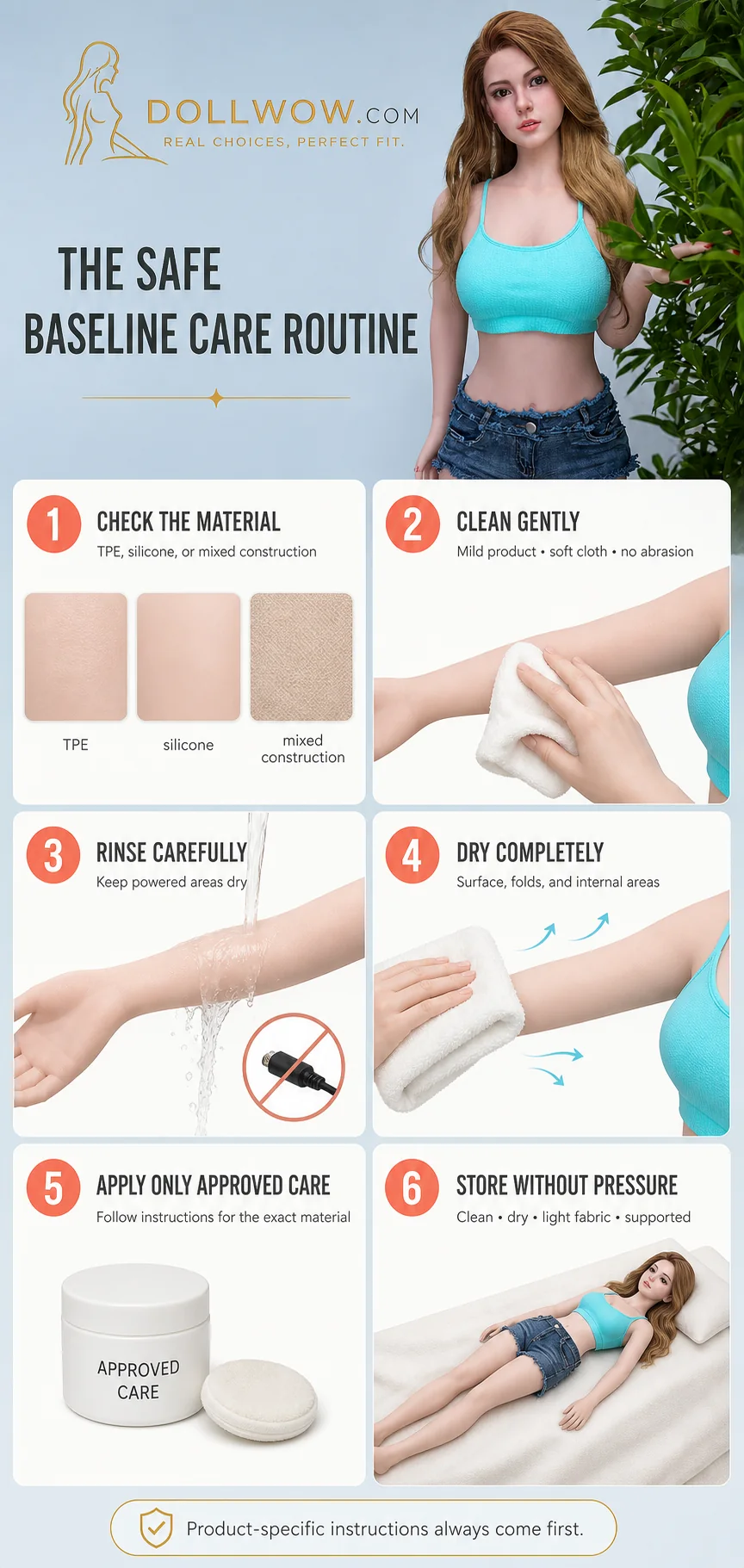
This seven-step routine is a cautious starting point for many TPE and silicone dolls. The manual supplied for the exact brand and model takes priority whenever it differs.
- Identify the complete construction. Confirm the body, head, insert, face, hair, electronics, and any mixed-material sections.
- Prepare a supported workspace. Use clean, light-colored towels on a stable surface that protects the doll from pressure and falls.
- Remove detachable items. Take off clothing, jewelry, wig, removable insert, and accessories according to the product instructions.
- Protect sensitive components. Switch off and disconnect electronic features. Keep water away from connectors, speakers, motors, batteries, charging ports, and unsealed openings.
- Clean gently. Use lukewarm water, a soft cloth or sponge, and only a mild cleaner confirmed for the exact material. Work in small sections without scrubbing or stretching the surface.
- Remove residue and dry completely. Wipe or rinse only as the manufacturer allows, pat dry, and make sure openings, folds, seams, and removable parts contain no trapped moisture.
- Finish and store by material. Apply powder or another surface treatment only when the manufacturer recommends it, then store the doll clean, dry, supported, and away from heat, sunlight, dark fabrics, and pressure points.
Cleaning should be controlled, not aggressive. More soap, hotter water, stronger chemicals, and harder scrubbing do not make a soft material safer.
Before You Start: Identify Every Material
The body material alone does not define the whole cleaning routine. A doll may combine a TPE body, silicone head, synthetic wig, painted face, removable insert, metal connector, and electronic features. Each can have different limits.
Check the product page, order confirmation, supplied manual, and any brand-specific care card for:
- TPE, full-silicone, or hybrid head-and-body construction
- Fixed or removable insert
- Painted or factory-applied makeup
- Implanted hair, rooted hair, or removable wig
- Electronic head, voice, heating, sensors, or other powered features
- Removable eyes, tongue, teeth, or accessories
- Neck connector, charging port, wiring, and waterproofing limits
- Recommended cleaner, powder, oil, drying tool, and storage position
Do not assume “water resistant” means the complete doll can be immersed. If the instructions are missing or unclear, ask DollWow through live chat or hello@dollwow.com before cleaning.
What You Need
Keep a simple kit dedicated to doll care. Do not reuse dirty household cleaning tools.
| Item | Purpose | What to avoid |
|---|---|---|
| Clean, light-colored towels | Support the doll and absorb surface water | Dark towels that may transfer dye |
| Soft lint-free cloth or sponge | Gentle surface cleaning | Rough sponges, brushes, or scrub pads |
| Lukewarm water | Controlled cleaning and residue removal | Very hot water, steam, or sudden temperature changes |
| Manufacturer-approved mild cleanser | Removes routine surface residue | Bleach, solvents, strong fragrances, and improvised disinfectants |
| Soft dry cloths | Patting the exterior dry | Rubbing painted areas or stretching soft material |
| Approved internal-cleaning tool | Rinsing a fixed opening when the manufacturer allows it | Sharp, rigid, rough, or oversized tools |
| Approved drying aid | Removing moisture from internal areas | High-heat hair dryers or inserting rough objects |
| Manufacturer-approved powder | Finishing some TPE surfaces after complete drying | Powder on a material or finish that does not call for it |
If the brand supplies a care kit, check each item against the exact doll rather than assuming every component is universal.
How To Clean The Body Surface
Place the doll on a stable, padded, light-colored surface. Keep joints in a natural position and support heavy sections before turning the body. Do not pull by the fingers, toes, wrists, ankles, neck, or head.
Work one small section at a time:
- Remove loose dust with a clean, dry, soft cloth when practical.
- Dampen a separate soft cloth or sponge with lukewarm water and the approved mild cleanser.
- Wipe with light pressure. Do not scrub, pinch, stretch, or repeatedly bend one area.
- Keep water away from the face, implanted hair, neck opening, electronics, and connectors unless the product instructions explicitly allow it.
- Remove cleaner residue using the method approved by the manufacturer, usually a clean damp cloth or controlled rinse on an allowed area.
- Pat the surface dry with a clean towel.
- Allow remaining moisture to evaporate in a clean, ventilated room before dressing or storing the doll.
Large full-body dolls can be difficult to reposition when wet. Plan each turn before you begin, keep the floor dry, and use a second adult or appropriate lifting equipment when the listed weight is beyond what you can move safely.
TPE, Silicone, And Hybrid Cleaning Differences
TPE and silicone are material families, not single recipes. Formulation, surface finish, pigments, paint, seams, and manufacturing methods vary. Use the table as a decision guide, then follow the exact brand instructions.
| Care question | TPE body | Full-silicone body | Hybrid doll |
|---|---|---|---|
| Routine cleaning | Gentle, controlled cleaning with a compatible mild product | Gentle, controlled cleaning with a compatible mild product | Treat the head and body as separate materials |
| Porosity | Generally more porous | Generally less porous, but still requires complete cleaning and drying | Depends on the section being cleaned |
| Powder after drying | Some manufacturers recommend it for tackiness and surface feel | Do not assume TPE powdering guidance applies | Use only on the section for which it is approved |
| Oils or conditioning | Formulation-specific and easy to overgeneralize | Do not apply TPE oil advice to silicone | Confirm separately for head and body |
| Stain response | Often more vulnerable to dye transfer | Can still stain or suffer finish damage | Use the correct material-specific path |
| Repair products | Requires a compatible TPE system | Requires a compatible silicone system | Match the product to the damaged section |
| Heat | Avoid unapproved heat | Avoid unapproved heat | Follow the most restrictive component guidance |
Read TPE vs silicone sex dolls for the broader material comparison.
If care effort affects your purchase, compare current TPE dolls, full-silicone dolls, and hybrid dolls before choosing a model.
Cleaning a TPE sex doll
TPE is commonly soft, elastic, and more porous than silicone. Clean promptly and dry thoroughly, but avoid excessive rubbing, stretching, and heat. Some TPE manufacturers recommend powder after the surface is fully dry. Others specify particular powders, oils, conditioners, or intervals.
Do not transfer a routine from one TPE brand to another without checking. An oil or stain treatment that works with one formulation may change the color, softness, tackiness, or strength of another. When the manual does not confirm a product, ask first.
Cleaning a silicone sex doll
Silicone is generally less porous and often supports a detailed surface finish, but it is not maintenance-free. Seams, folds, fixed openings, painted areas, implanted hair, and electronic components still need careful treatment and complete drying.
Do not assume silicone should be powdered or oiled because a TPE guide recommends it. Do not use silicone adhesive, lubricant, polish, or household sealant as a cleaner. Similar names do not prove compatibility with the doll's cured material or finish.
Cleaning a hybrid doll
A common hybrid combines a silicone head with a TPE body. Remove the head only according to the supplied instructions and protect the connector. Clean the face and body through their separate approved routines. Avoid leaving unconfirmed products or wet materials in contact at the neck during storage.
How To Clean A Fixed Internal Opening
Internal cleaning requires more care because moisture can remain where you cannot see it. Use only tools approved for the opening and material. If the doll contains electronics, heating, sensors, or internal wiring near the area, obtain product-specific instructions first.
A cautious process is:
- Position and support the doll according to the manufacturer guidance.
- Use an approved irrigator or cleaning tool with lukewarm water and the confirmed cleanser.
- Avoid high pressure, sharp tips, rigid tools, and forceful insertion.
- Flush only as much as needed to remove cleanser and residue.
- Allow water to drain without twisting or sharply bending the body.
- Use an approved soft absorbent or drying tool without scraping the interior.
- Continue air drying or use a cool-air device only when the manufacturer recommends it.
- Confirm that the opening is completely dry before storage.
Do not seal a damp opening with clothing, an insert, a plug, or storage fabric. If persistent odor, discoloration, residue, or suspected mold remains after cleaning, stop using the product and contact support before applying stronger chemicals.
How To Clean A Removable Insert
A removable insert can simplify cleaning because it can be handled separately. Remove it without stretching the opening beyond the product guidance.
- Remove the insert as instructed for the model.
- Rinse and clean it with the approved mild product and lukewarm water.
- Remove all cleaner residue.
- Dry the inside and outside completely using the approved method.
- Apply powder or another finish only if the insert instructions require it.
- Reinstall it only when both the insert and body cavity are dry, or store it separately as directed.
Avoid turning an insert inside out unless the manufacturer explicitly permits it. Some constructions can tear, deform, or separate when reversed.
Face, Makeup, Eyes, Hair, And Wig Care
The face is often the most detailed and easiest area to alter accidentally.
Face and makeup
Use minimal moisture and almost no pressure unless the manufacturer provides a different method. Avoid rubbing eyebrows, lips, lashes, blush, freckles, tattoos, and other painted details. Makeup remover, skincare products, oils, and cosmetics can dissolve, stain, or change a factory finish.
If a mark is close to painted detail, photograph it and ask support before cleaning. A small untreated mark is often easier to address than removed face paint.
Eyes and mouth
Removable eyes, teeth, or tongues should be handled only according to the model instructions. Do not flood the head or allow water to enter an electronic mechanism. Use separate clean tools when the manufacturer permits cleaning a removable component.
Wigs and implanted hair
Remove a wig before cleaning the body. Wash and style it according to the wig material and supplier guidance, not the body routine. Let both the wig and doll head dry before reattachment.
Implanted or rooted hair can make the head more sensitive to water, pulling, heat, and product buildup. Do not soak the scalp or use ordinary hair products without confirmation. Read the implanted hair vs wig guide before selecting a hair system.
Electronics, Heating, And Powered Features
Powered features change the cleaning boundary. Before any water is used:
- Switch the feature off.
- Disconnect the power source or charger.
- Remove batteries when the manufacturer instructs you to do so.
- Locate charging ports, speakers, vents, sensors, control boxes, and cable exits.
- Confirm which components are removable and which areas are water resistant.
- Never immerse a powered head, body, or module unless the manufacturer expressly permits it.
- Allow the product to dry completely before reconnecting power.
If water enters an electrical component, do not switch it on to “test” it. Disconnect power and contact DollWow for the brand-specific next step.
Drying: The Step That Prevents Many Problems
Cleaning is incomplete until every cleaned area is dry.
Pat the exterior with a clean, soft towel. Pay attention to folds, seams, fingers, toes, underarms, the neck connection, and areas resting against the support surface. Turn the doll only with adequate support, then check the side that was underneath.
For internal areas, use the drying method approved by the manufacturer. This may involve a compatible absorbent tool, removable insert, or cool-air device. Do not use high heat, push rough objects into an opening, or assume the visible entrance represents the moisture deeper inside.
Give the doll enough ventilated time to dry before applying powder, dressing it, closing a case, or moving it into long-term storage. The exact drying time depends on the material, opening, room, and method, so a universal number would be misleading.
Powder, Oil, And Surface Treatments
Internet guides often present powdering or oiling as a universal step. It is not.
Some TPE manufacturers recommend a specific powder after cleaning and complete drying to reduce tackiness and maintain surface feel. Some also publish conditioning guidance for their formulations. Silicone, painted areas, soft-silicone finishes, and mixed-material parts may follow different rules.
Before applying anything, confirm:
- Exact product name and ingredients
- Material and brand compatibility
- Areas where it may and may not be used
- Amount and application method
- Whether the doll must be washed first
- Whether the product changes paint, makeup, bonding, or repairs
- Required waiting and removal steps
Do not apply baby oil, petroleum jelly, cornstarch, talc, disinfectant, or another frequently recommended product merely because it appears in a general forum post. The safest product is the one confirmed for the exact doll.
Stains Are Different From Dirt
A surface mark may be loose dirt, transferred dye, pigment absorbed into the material, makeup damage, or a chemical reaction. Scrubbing harder can spread the problem or remove the doll's own color.
When you find a stain:
- Remove the source, such as dark clothing or a wig cap.
- Photograph the area in neutral light.
- Record the material, brand, contact item, and approximate time of exposure.
- Use only the first cleaning step approved for that model.
- Stop if the doll's finish changes or the mark does not lift.
- Ask DollWow before applying a stain remover, oil, solvent, heat, or prolonged treatment.
Prevention is easier. Wash new clothing separately, use light and colorfast barriers, and do not store the doll in dark or highly saturated fabrics. The sex doll storage guide covers dye transfer and pressure planning in more detail.
What Not To Use Without Exact Approval
- Bleach or chlorine products
- Alcohol-heavy cleaners or disinfectants
- Hydrogen peroxide or other oxidizers
- Acetone, paint thinner, adhesive remover, or household solvents
- Abrasive powders, scrub pads, or stiff brushes
- Steam cleaners, boiling water, heating pads, or hot hair dryers
- Essential oils, fragranced oils, massage oils, or skincare products
- Household stain remover or laundry treatment
- Silicone adhesive, TPE solvent, or repair glue as a cleaner
- Powder, oil, conditioner, or disinfectant recommended only for another brand
This list is deliberately cautious. A manufacturer may approve a particular product for a particular formulation and purpose, but that does not make it a universal cleaning step.
How Often Should You Clean A Sex Doll?
Clean contact areas after use and clean dust, residue, or accidental spills when they occur. Inspect the doll before and after handling. The rest of the schedule depends on material, environment, storage, clothing, frequency of use, and manufacturer instructions.
Avoid unnecessary full-body washing when controlled spot cleaning is sufficient. Repeated wetting, moving, and repositioning add handling risk. At the same time, do not delay cleaning an internal area or residue that should be removed promptly.
A practical routine has four levels:
- After use: clean and dry contact areas according to the manual.
- As needed: remove dust, residue, or spills with a gentle spot clean.
- Before storage: confirm the entire doll and all parts are clean and completely dry.
- Periodic inspection: check high-stress areas, seams, joints, connectors, painted details, clothing contact points, and stored accessories.
Cleaning And Storage Checklist
- I confirmed the exact head, body, insert, and material construction.
- I read the current brand or model care instructions.
- Electronics are off, disconnected, and protected.
- The doll is supported on clean, light-colored towels.
- I am using a soft tool and a confirmed mild cleaner.
- I am cleaning in small sections without scrubbing or stretching.
- Cleaner residue has been removed by an approved method.
- Exterior surfaces, folds, seams, and openings are completely dry.
- The wig and removable parts are clean and dry separately.
- Powder, oil, or treatment is being used only if confirmed.
- I checked for stains, tears, joint concerns, and finish changes.
- The storage surface is clean, dry, colorfast, and properly supported.
Common Cleaning Mistakes
Using a universal recipe
TPE, silicone, hybrid construction, paint, hair, electronics, and inserts can require different treatment. Start with the exact product.
Treating stronger as cleaner
Harsh chemicals, high heat, and abrasion can damage the surface while creating a new problem. Use the least aggressive confirmed method.
Forgetting the underside and internal areas
The visible surface may be dry while moisture remains in a fold, opening, removable insert, or the side resting on a towel.
Cleaning the face like the body
Painted details, lashes, eyes, lips, and implanted hair deserve a separate, gentler path.
Reconnecting electronics too soon
Do not power a feature until every relevant component is dry and the instructions say it is ready.
Applying powder or oil before complete drying
Surface treatments are not a substitute for drying and can make trapped residue harder to detect.
Storing the doll immediately
Closing a case or dressing a damp doll can trap moisture and create fabric contact risks. Finish the drying check first.
DollWow Cleaning And Repair Support
DollWow can help identify the product material, locate available manufacturer guidance, and review a cleaner, powder, stain, tear, or electronic concern before you act. Send clear photos, the product or order link, the brand and model, and what has already touched the surface through live chat or hello@dollwow.com.
Every DollWow doll includes Care 365 under the current published terms, with continuing Repair Concierge help after the first year. If cleaning reveals a cut, loose area, stain, joint concern, or electrical problem, stop and ask before attempting a repair that could make it harder to correct.
Manufacturer Care Sources
- Tantaly: official cleaning and maintenance guidance
- RealDoll: official Classics care and maintenance guide (PDF)
- Irontech: official silicone material guidance
- ZELEX: official doll care guide
These manufacturer sources support the guide's cautious approach to material identification, mild cleaning, painted-detail protection, complete drying, and model-specific instructions. They also show why one brand's cleaner, temperature limit, powder, oil, insert method, or electronics boundary should not be treated as universal. Follow the manual supplied with your exact doll whenever it differs.
FAQs
What is the safest way to clean a sex doll?
Confirm the exact materials and manual, protect electronics, use lukewarm water with a soft cloth and a manufacturer-approved mild cleaner, remove residue, and dry the exterior and internal areas completely. Use powders, oils, disinfectants, and stain treatments only when approved for that model.
Can I use regular soap to clean a sex doll?
Only when the manufacturer confirms that the soap is mild and compatible with the exact material and finish. Some soaps leave residue or contain fragrances, moisturizers, alcohol, or other ingredients that may not suit a doll.
How do I clean a TPE sex doll?
Use gentle, low-friction cleaning with an approved mild product and dry it thoroughly. TPE formulations vary, so confirm the brand's instructions before powdering, oiling, disinfecting, or using stain remover.
How do I clean a silicone sex doll?
Use a soft cloth or approved tool, lukewarm water, and a mild cleaner confirmed for the silicone formulation. Protect painted details, implanted hair, openings, connectors, and electronics, then dry every area completely. Do not apply TPE oil or powder advice automatically.
Can I put a sex doll in the bath or shower?
Only if the manufacturer explicitly approves that method for the complete product. Weight, slippery handling, neck connectors, implanted hair, electronics, and unsealed openings can make immersion or shower cleaning unsafe for the doll.
How do I dry the inside of a sex doll?
Use the manufacturer-approved absorbent or cool-air drying method without sharp tools, abrasion, or high heat. A removable insert should be dried separately when allowed. Do not store the doll until the internal area is completely dry.
Should I use powder after cleaning a sex doll?
Some TPE manufacturers recommend a compatible powder after the surface is fully dry. Silicone and specialty finishes may follow different guidance. Confirm the exact material, powder, and application method first.
Can I use baby oil on a TPE doll?
Do not assume it is safe for every TPE formulation. Some manufacturers publish specific conditioning instructions, while other products or finishes can react differently. Ask for the exact brand guidance before applying oil.
Can I use alcohol or bleach to disinfect a sex doll?
Do not use alcohol, bleach, or another disinfectant unless the manufacturer explicitly approves the exact product, concentration, area, and method. These chemicals can dry, discolor, weaken, or otherwise damage some materials and finishes.
How often should I clean a sex doll?
Clean contact areas after use, remove dust or spills as needed, and make sure the doll is clean and dry before storage. The complete schedule depends on the material, environment, storage, use, and manufacturer guidance.
How do I remove a clothing stain from a sex doll?
Remove the fabric, photograph the mark, and identify the material and brand. Start only with the approved gentle cleaning step. Do not scrub or apply a stain remover, oil, solvent, or heat until compatibility is confirmed.
What should I do if I notice odor, discoloration, or possible mold?
Stop using the affected area, keep it dry and separate from clothing or storage materials, document what you see, and contact DollWow or the manufacturer. Do not hide the issue with fragrance or improvise with stronger chemicals.
Can DollWow confirm care instructions for my exact doll?
Yes. Send the product or order link, brand, model, material, photos, and your question through live chat or hello@dollwow.com. DollWow can check available manufacturer guidance and explain what still needs confirmation.