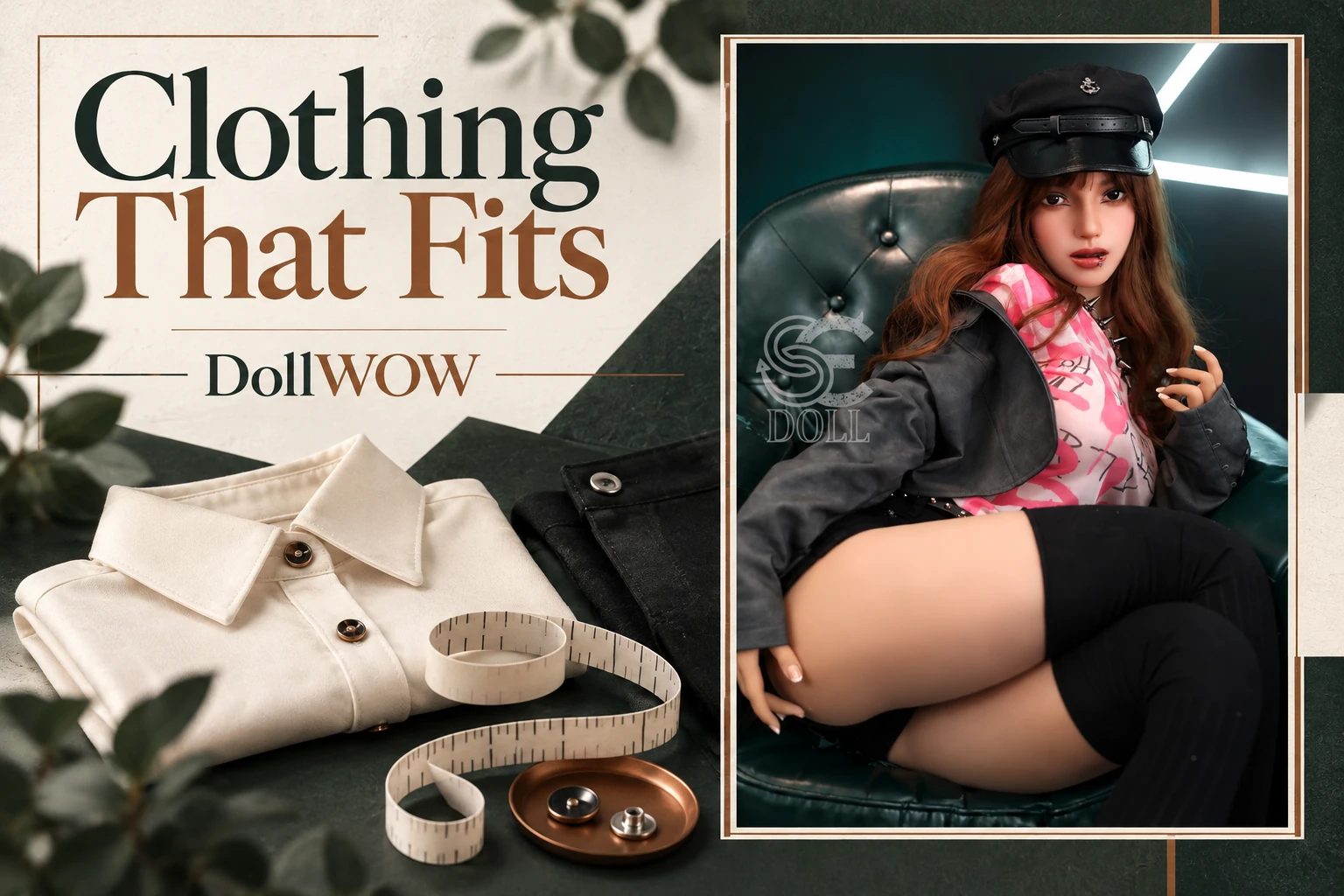
"Small" is not a measurement. Two outfits with the same size label can fit very differently, and a doll's proportions may not follow the body shape used for a clothing brand's chart. Start with centimetres or inches, then work toward a size label.
The aim is to choose clothing that fits without stretching it over the doll by force. A flattering product photograph is useful inspiration, but it cannot replace the dimensions of the particular body you own.
Build a short measurement record
Keep the exact body code beside the measurements. A face name alone may identify more than one body configuration.
| Record | Most useful when choosing |
|---|---|
| Bust or chest circumference | Fitted tops, shirts and dresses |
| Waist circumference | Waistbands, skirts and fitted dresses |
| Hip circumference | Trousers, shorts and fitted skirts |
| Shoulder width and arm length | Shirts, jackets and sleeves |
| Torso length | Bodysuits and close-fitting one-piece outfits |
| Inside leg and intended rise | Trousers and leggings |
| Foot length and width | Footwear |
Use your product's confirmed specification as a starting point. For measurements absent from the table, take a careful measurement of the actual doll rather than calculating it from height. Follow the manufacturer's handling instructions while positioning it.
If using a soft tape, keep it flat and do not pull it tight enough to compress the material. Record the unit once at the top of the sheet. Our size and weight guide covers the wider body-selection decision; this worksheet is for clothing fit.
Simplicity's measurement guidance places the bust tape around the fullest area and across the back, and the hip tape around the fullest hip area. Its instructions and size charts are for people, not doll-specific sizing. On a doll, follow the actual shape and the garment maker's landmarks; do not assume a human chart's fixed distance below the waist locates every body's widest point. Record the waist position you used so a repeat reading follows the same path.
Read what the clothing chart measures
Some size charts describe the wearer the garment is intended to fit. Others give measurements of the garment itself. Those figures are not interchangeable.
Simplicity's pattern-envelope guide distinguishes body measurements from finished garment dimensions, which help show the intended fullness or ease. That distinction is useful even when buying ready-made clothing: a garment's circumference need not equal the body's circumference, and a finished-size chart must be interpreted for its fabric and intended fit.
A flat waistband measurement, for example, is not the same thing as a body waist circumference. A simple waistband measuring 32 cm across when laid flat has an approximate 64 cm circumference before stretching. That calculation still says nothing about its comfortable fit range or the opening needed to pass over the hips. The listing should say whether a dimension is laid flat, measured around the garment or intended as a body measurement. If it does not, ask which convention the chart uses.
Check the material and fastening as well. A zip, buttons or adjustable closure may make dressing more practical than an equally sized item with a small fixed opening. Stretch fabric still has limits; the word "stretch" is not a substitute for a fit range.
A worked example, not a size recommendation
Suppose a hypothetical body measures 90 cm at the bust, 64 cm at the waist and 100 cm at the hips. A clothing chart lists a size for a 88-92 cm bust, 60-64 cm waist and 92-96 cm hip.
The bust and waist fall inside that chart's body ranges, but the hip measurement does not. That rules out this chart size for the intended fitted silhouette; it does not prove the garment would fit elsewhere. Both the body and chart in this example are hypothetical, not a measured DollWOW model or a garment recommendation.
| Hypothetical fit check | Finding | Decision |
|---|---|---|
| Bust: 90 cm against 88-92 cm | Inside the stated body range | Continue checking; not a complete fit result |
| Waist: 64 cm against 60-64 cm | At the upper limit | Check fastening and whether the chart allows the intended fit |
| Hips: 100 cm against 92-96 cm | Outside the stated range | Do not select this size for a fitted dress |
| Opening and fabric | Not specified in this example | Resolve before buying; do not assume stretch solves the mismatch |
For a fitted dress, check all relevant dimensions together. For a loose top, the hem opening and shoulders may matter more than a hip dimension it never reaches. Fit depends on the garment you are buying, not a universal clothing conversion table.
Can the outfit be put on without forcing it?
An outfit can match the final measurements but still be difficult to put on. Think through the dressing route: the neck opening, sleeve openings, waist fastening and the widest point the garment must pass over.
Do not assume fingers, joints or soft areas can be bent or compressed to make an opening work. Choose a more accessible fastening instead. Remove jewellery or other items that could catch while dressing, and follow the care directions for the exact doll.
Irontech's care guidance recommends gentle clothing changes and smooth fabrics to reduce friction on painted surfaces. That is a useful reminder to consider the finish as well as the fit. Factory care guidance
Keep the first wardrobe simple
Before buying several outfits, check one suitable garment against the actual measurements. Keep a note of its brand, product name, size, fabric and fit. A record of what genuinely fits your particular body is more useful than a general "doll size" label.
Photographed outfits are included only where the product or offer explicitly says so. Check the order contents separately from the clothes you intend to buy.
Use custom doll listings to compare the body measurements that matter to you, then keep the care and maintenance checklist alongside your clothing notes.